Reviews & Rants · Comics
Comic Shops Aren’t Supposed to Be Scalpers
By Peter David · August 8, 2026 · Cobra Kai Never Lies
DC is finally putting comic shops on notice over ridiculous prices on retailer-exclusive variant covers. Good. Because somewhere along the way, some stores stopped protecting collectors from scalpers and started acting just like them.
I love comic shops.
I want to get that out of the way right now because I know where this is going to sound like it's headed.
Where I grew up we didn't really have comic shops. Sure, there were a few that popped up every now and again, stuck around for a year or two and inevitably closed like their ancestors before. I had to get my books off the rack in the local liquor store.
It wasn't until I moved to a much larger area in my teenage years that I discovered just how great a real established comic store could be. To this day, I still love walking into one and looking through the new books, the back issues, figures, statues and whatever other shit they've managed to cram into every available square inch. A good comic shop is still one of my favorite places to waste time and money.
But now it seems like some comic shops out there have picked up a really shitty habit. They've become scalpers in their own world. And DC Comics finally seems to have had enough of it! Or at least a small part of it that involves DC. Yay DC?
DC has now changed the rules surrounding its retailer-exclusive variant covers. The company is now discouraging retailers from selling unsigned exclusives for more than five times the regular cover price and signed versions for more than ten times the cover price. DC isn't outright setting prices, but stores that push things too far can potentially lose access to future retailer-exclusive variants.
Good. Actually, really fucking good!
Because if a comic costs five bucks and your store has a cool limited variant edition, I can understand charging more for it. The shop had to order a bunch of copies, take the risk that they'll actually sell and hopefully make some money. That's business. Everybody can understand that.
If it's signed, fine, there may be some additional cost involved there too.
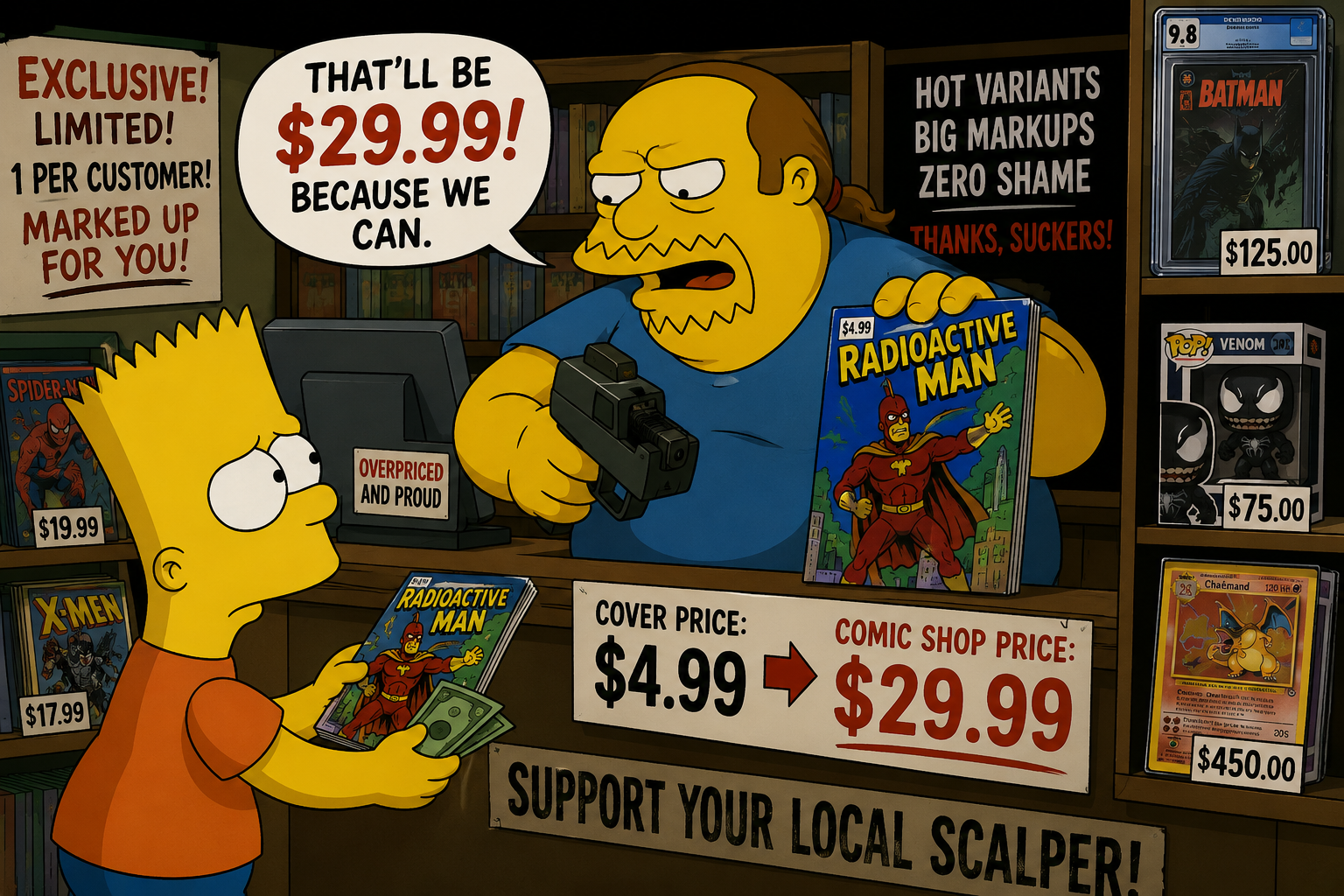
Taking that same $5 comic, putting a different picture on the front and immediately deciding it's worth $75, $100 or $150 because you know collectors want it? That's what we call scalping kiddos.
The Comic Isn't Worth $100 Yet
There's something about this whole thing that's always bothered me. A collectible becoming valuable over time is part of collecting. That's half the fun. Books disappear, get damaged, whatever. This should naturally raise the prices as it would anything.
Maybe you bought a comic for $3.99 twenty years ago and now it's worth $300. Maybe you bought a figure that disappeared from stores and suddenly everybody wants it. Maybe some card you pulled out of a pack goes through the roof.
That's the market deciding what something is worth. But now we've reached this strange place where some retailers want to skip that entire process. The fucking thing isn't even out yet and they've already decided it's rare. They've decided it's valuable.
They've decided you need to pay collector-market prices for something they're selling at retail for the very first time. How exactly does that work? Are comics now like new cars? Take them out of the store and they lose 50% of their value.
The collector never even gets the opportunity to determine the value because the store decided what the secondary-market price should be before there was a secondary market. That's what we in the business call bullshit.
And limited variant editions have gotten completely out of control. A book like Absolute Batman can have more than 30 variants for a single issue.
Thirty.
At that point we're barely collecting different comic books anymore. We're collecting different pieces of cardboard wrapped around the same comic. I'm not even against variant covers. Some of them are fucking gorgeous. I've bought them. I'll buy more of them. It's a great way to get more artists some attention.
But a cool cover doesn't magically turn a five-dollar comic into a hundred-dollar collectible the moment somebody puts it on a shelf.
I've Been on the Other Side of This
And this isn't just about comics. Stores pull this shit with collectibles all the time.
Years ago, I pulled a Rainbow Full Art Charizard card. I sold it to a shop for $125. They turned around and put that fucking thing up for $450.
Now, before somebody starts yelling about how businesses work, yes, I understand that a store has to make money.
They've got rent. Employees. Insurance. Inventory that sits around forever. They buy things that don't sell. They need enough margin to keep the doors open. I'm not expecting them to give me $124 for something they're going to sell for $125.
But $125 to $450? Come on now.
If some guy bought that card from me for $125, immediately went home and listed it online for $450, we'd call him a scalper. Put a cash register between us and suddenly it's just good business?
I don't buy that and nobody else should either.
Stores Can't Have It Both Ways
This is the part of the collector market that drives me nuts. Walk into a store trying to sell something and suddenly every flaw matters. There's one on eBay for $300? Doesn't matter. That's the asking price.
One sold for $250? Yeah, but there are fees. It's rare? Maybe, but they don't know how long it'll sit there. They've already got two? That lowers what they can offer. And again, some of that is completely legitimate.
Then the transaction ends, the item goes into the display case and apparently a fucking miracle occurs. Suddenly it's incredibly rare. Now the eBay prices matter. Magically somebody else's highest asking price is a perfectly reasonable comparison.
Poof! The thing they just explained wasn't worth very much is worth three times what they paid you for it. That's where you lose me. A store should make a profit. Absolutely. A store shouldn't be expected to operate like a charity for collectors.
But there's a gigantic area between making a profit and seeing how desperate somebody is to own something.
And Yes, Collectors Are Part of the Problem
Here's the part nobody wants to hear. This shit only works because we keep paying. Someone puts a $100 price tag on a brand-new variant because eventually somebody is afraid enough of missing it that they'll hand over the money.
Who hasn't had that fear of missing out? You don't want to be the person who passed on it. You don't want the empty spot in the collection. You don't want to see it selling for $200 six months from now and think, “Fuck, I should've bought it.”
Retailers know that. Publishers know that.
Every company selling “limited,” “exclusive,” “chase,” “platinum,” “convention exclusive” or whatever other word they've come up with this week knows that. Scarcity sells better than sex.
But there's a difference between something actually becoming scarce and somebody manufacturing scarcity so they can charge you for being nervous. That's why I like what DC is doing here.
They're not banning limited variant editions. They're not telling stores they can't make money. Hell, five times cover price is still one hell of a markup.
They're basically saying:
Make your money, but don't be an asshole about it.
Seems reasonable to me.
Let the Collectors Decide What It's Worth
If somebody buys a $25 variant and two years from now another collector wants to pay $200 for it, fine. That's collecting. That's supply and demand. That's the secondary market.
Maybe the buyer is brilliant. Maybe they're an idiot. Maybe that comic will be worth $500 someday. Maybe it'll be sitting in a dollar bin ten years from now. The gamble is real.
But the store selling the comic for the first time shouldn't also get to play speculator and decide what the collectible market is going to value it at. You're the retailer. Sell me the comic. Let the rest of us figure out what the damn thing is worth after that.
Comic shops are supposed to be part of the hobby, not another obstacle collectors have to get through.
If you're charging secondary-market prices before the fucking thing has even reached the secondary market, you're not beating the scalpers anymore.
You are the scalper.