Reviews & Rants · Collector Rant
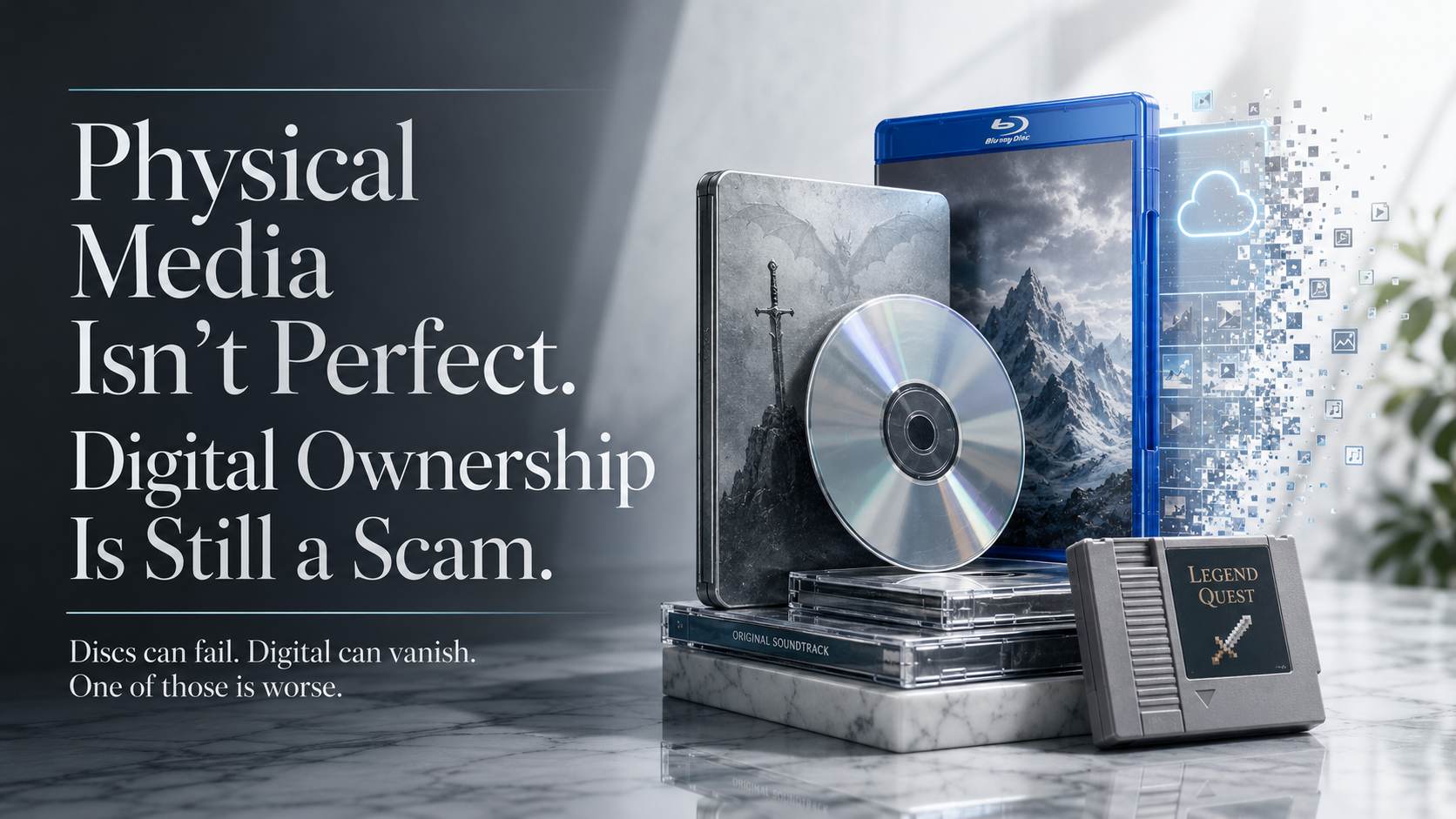
Physical Media Isn’t Perfect. Digital Ownership Is Still a Scam.
By Peter David · July 9, 2026 · Cobra Kai Never Lies
Discs can fail. Digital can vanish. One of those is worse.
There was a time when people made fun of the physical media crowd. The Blu-ray people. The DVD people. The game cartridge people. The lunatics with shelves, slipcovers, steelbooks, box sets, and enough plastic cases to fill a storage unit.
They were told they were clinging to the past. They were told everything was digital now. They were told owning movies and games was outdated, wasteful, unnecessary, and maybe a little weird. Fine. Maybe it was weird. Collectors have never exactly been accused of being normal.
But now those same “why do you still buy discs?” people are staring at digital libraries like a raccoon looking into an empty trash can, because it turns out “buy” doesn’t always mean buy. Sometimes “buy” means, “Congratulations, you’ve purchased temporary access to this content until a licensing agreement gets stabbed in the heart by a CEO who got pissed off at New Line Cinema.”
Sony just gave everybody another reminder of that miserable little truth. PlayStation’s own legal notice says that starting September 1, 2026, customers will no longer be able to access previously purchased StudioCanal content because of licensing agreements. Wired reported that this affects 551 purchased movies and TV shows in the UK, including Terminator 2: Judgment Day, Paddington, and Pan’s Labyrinth.
These weren’t just random subscription titles floating around on a streaming service. These were purchases sitting in people’s libraries. Which makes the whole thing feel less like a business decision and more like someone sneaking into your house, taking your movie shelf, and then explaining the shelf was never truly yours.
This is usually the part where someone says, “Well, technically, you only bought a license.” Great. Wonderful. Thank you, Professor Fine Print. That may be technically true, but that’s exactly the problem.
Normal people don’t hit a button that says “buy,” pay full price, and think, “Ah yes, I’ve entered a fragile corporate permission arrangement that may collapse when two companies stop liking each other’s paperwork.” They think they bought the movie, because that’s what the word “buy” means to people who haven’t been spiritually ruined by legal departments.
Sony isn’t exactly helping its case on the gaming side either. The official PlayStation Blog says physical disc production for all new games releasing on PlayStation consoles will be discontinued starting in January 2028, with new games available through the PlayStation Store and retailers in digital formats only. That doesn’t affect games already released, or games releasing before January 2028, but it sure as hell tells you where this road is going.
Sony is telling everyone the future is digital while also reminding everyone that digital purchases can disappear when licensing changes. That’s not confidence-building. That’s watching someone burn down a garage and then announce they’re opening a fireworks warehouse.
Gaming has been crawling toward this cliff for years. Digital-only consoles. Day-one patches. Online checks. Server-dependent features. Games that ship broken and get repaired later like the customer is part of an unpaid quality-control department. Do I even need to mention the Cyberpunk 2077 shitshow?
Nintendo has its own version of this with Switch 2 game-key cards. Nintendo’s support page explains that the full game isn’t included on the game-key card and must be downloaded before you can play. The card is still needed after download to start the game, so it’s not a pure download code, but it also isn’t a complete game sitting on a cartridge. It’s physical-ish. It’s ownership-adjacent. It’s a little plastic hall pass that says, “Please, sir, may I access the thing I thought I bought?”
And look, nobody is pretending modern games are tiny. Some of these things have file sizes that look like they were assembled by an intern with an axe to grind. There are practical reasons companies want to move away from discs and cartridges. But practical doesn’t automatically mean good for the customer. Cheaper for the company doesn’t mean better for ownership. Convenient doesn’t mean permanent.
Before the digital-only crowd starts dancing on the grave of the DVD shelf, physical media has problems too. Warner Bros. DVD collectors have been dealing with their own little horror movie, with reports that DVDs manufactured during the 2006–2008 window may be failing early from disc rot. Consequence reported that Warner Bros. Home Entertainment acknowledged that some DVDs from that period may be affected and has been working with customers on replacements where possible.
So no, physical media isn’t some holy artifact protected by the ghost of Blockbuster. Discs can rot. Cases can crack. Players can die. Cartridges can fail. Manufacturing defects can turn your beloved movie into a shiny circle of sadness.
But here’s the difference: when a disc dies, the object failed. When a digital purchase disappears, the deal failed.
That’s the uglier problem. A defective disc is frustrating, but at least the failure makes sense. The copy existed. The object broke. Something physical broke. A vanished digital purchase is different. That’s not your shelf collapsing. That’s someone else changing the rules after they already took your money.
This isn’t just old man yelling at cloud storage. This is about ownership being slowly shaved down until it barely means anything. Movies disappear from libraries. Shows get memory-holed from streaming services. Games become unplayable because servers shut down. Physical releases get replaced by download codes, key cards, or empty boxes with a logo and a prayer.
That’s the con. They want ownership prices with rental rights. They want collector loyalty without collector guarantees. They want us to pay full freight for products that can vanish, expire, fail, deactivate, delist, or get locked behind some future account system that no longer recognizes the email address you made in 2009.
Then they act confused when people start buying Blu-rays again. They act surprised when vinyl comes back. They act shocked when collectors still want discs, cartridges, cases, manuals, steelbooks, slipcovers, and shelves that look like a Best Buy from 2006 had a nervous breakdown. It’s not because physical media is perfect. It’s because at least physical media has the decency to exist in the room with you.
Physical media isn’t just nostalgia. It’s leverage. It’s evidence. It’s the thing on your shelf that doesn’t need a licensing agreement to continue being there. The Warner Bros. DVD issue proves that anyone calling physical media bulletproof is selling fairy tales, but imperfect ownership is still better than imaginary ownership.
That’s why physical media matters more than ever. Not because discs are magic. Not because collectors are always right. Physical media matters because corporations have spent the last decade teaching us that access is not ownership, purchase buttons are not promises, and your digital library is only permanent until someone decides it isn’t.
So yes, keep your Blu-rays. Keep your DVDs. Keep your games. Keep your weird special editions, your ugly steelbooks, your scratched slipcovers, your out-of-print box sets, and the movie nobody streams anymore. Keep the game that needs no server. Keep the copy that exists because you own it, not because a corporation currently feels generous enough to let you look at it.
The physical media obsessives weren’t wrong. They were early.
Update: Sony is now arguing in federal court that digital PlayStation game purchases are licenses rather than ownership. I followed up on that argument here.
Sources: PlayStation · Wired · PlayStation Blog · Nintendo Support · Consequence