News · Games
Nobody Is Buying Xbox, So Microsoft Raised the Price
By Peter David · August 3, 2026 · Cobra Kai Never Lies
Xbox hardware sales have been collapsing for months, so Microsoft responded by charging as much as $150 more for the same aging consoles.
Xbox consoles aren’t selling.
Naturally, Microsoft looked at that situation and decided the obvious solution was to make them considerably more expensive.
Beginning August 1, Microsoft raised the worldwide price of every remaining Xbox Series X and Series S model. The 512GB consoles went up by $100, while the 1TB models increased by $150. Microsoft is also discontinuing the 2TB Xbox Series X entirely.
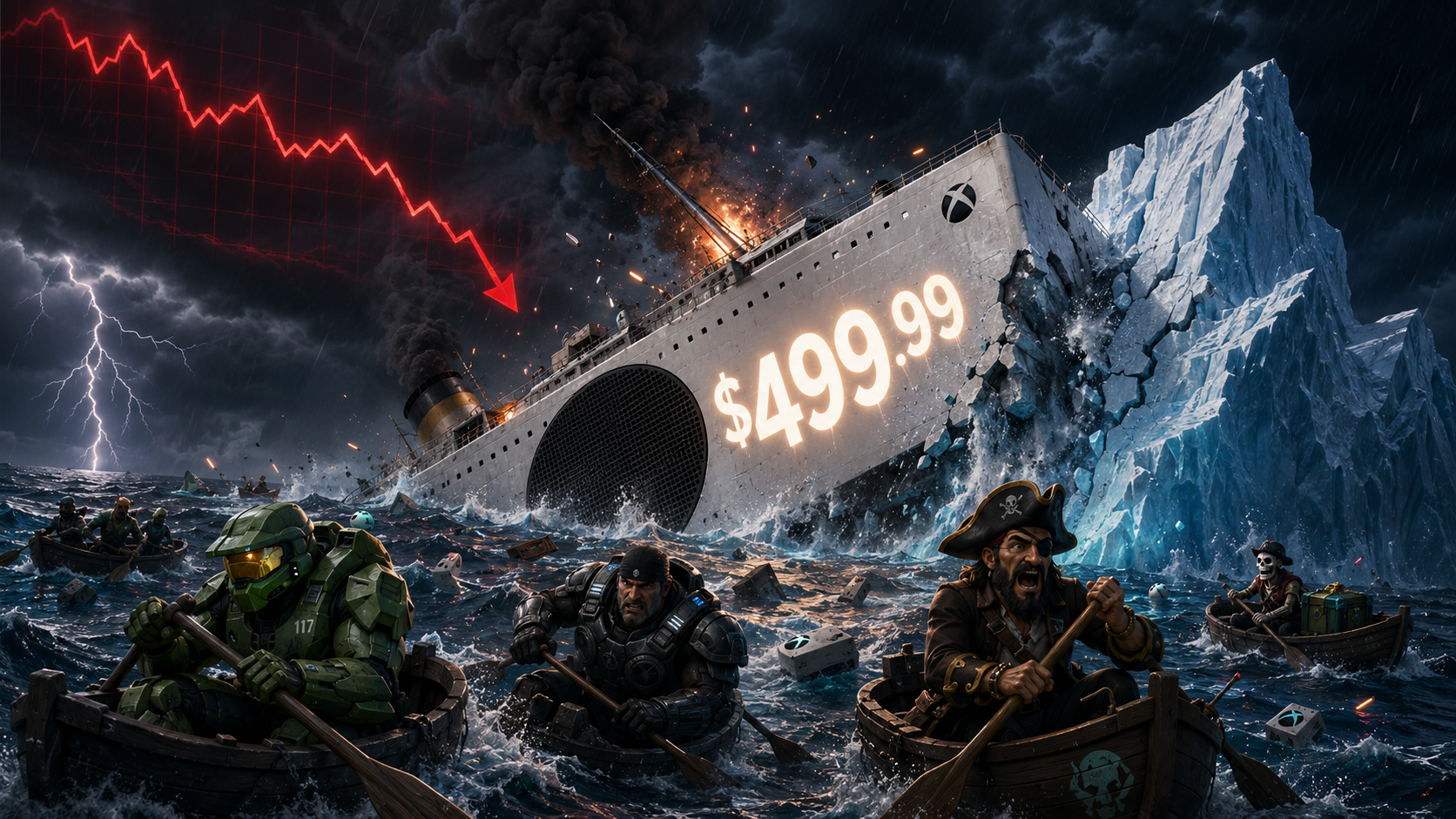
That means the cheapest Xbox Series S now costs $499.99.
Five hundred fucking dollars. For a Series S Xbox. That's the low end model.
The Xbox Series S originally launched as the cheap way into the current generation. It was the system you bought when you didn’t care about discs, didn’t need the strongest hardware and just wanted access to Game Pass without spending a fortune.
It launched for $299.99. I got one free from Verizon. That same basic idea now costs $499.99. At that price, it’s no longer the affordable Xbox. It’s just the weaker Xbox that somehow costs what the actual Xbox Series X cost when this generation started.
The 1TB Series S is now $599.99. The all-digital Series X is $749.99, and the regular Series X with a disc drive has climbed even higher depending on the market and model.
Microsoft officially blamed rising hardware, memory and storage costs for the increases. That explanation may be real, but it doesn’t make these prices any less insane. The Xbox Series X launched in 2020 for $499. We’re now six years into the same console generation, and Microsoft wants significantly more money for the same system.
Consoles are supposed to get cheaper as they get older.
Maybe they get smaller. Maybe manufacturing becomes easier. Maybe companies introduce a lower-priced model to bring in people who didn’t buy one during the first few years. Xbox apparently looked at that entire history and decided to do the exact opposite.
The system is older. The hardware is falling further behind newer technology. Fewer people are buying it. So, naturally they raise the price.
It’s a bold strategy. Let's see how this works out for them.
Microsoft’s own financial reports show exactly how badly Xbox hardware has been performing. Hardware revenue fell 29% during the first quarter of the fiscal year, 32% during the second and 33% during the third. Microsoft didn’t provide a separate hardware percentage for its latest quarter, but total Xbox revenue fell another 10%.
Those aren’t the numbers of a healthy console business experiencing one bad month. That’s a pattern. People have repeatedly decided they don’t need an Xbox, and Microsoft keeps giving them more reasons to feel confident about that decision.
Xbox has spent years teaching people that they don’t need an Xbox console. Its games are on PC. More of its biggest games are appearing on PlayStation. Game Pass can be accessed through cloud streaming, computers, handhelds, televisions and other devices. Microsoft’s entire message has become that anything can be an Xbox.
Except now an actual Xbox is one of the worst and most expensive ways to be an Xbox. Why would someone spend $500 on a Series S when that system was specifically designed to be the cheap version? Why would someone spend considerably more on a Series X when Microsoft is releasing more of its games on competing hardware? Why would a new buyer choose the console with the weakest sales momentum, the least commitment to exclusives and the most confusing long-term identity?
Microsoft seems determined to answer all those questions with another question: What if we charged them even more?
The Xbox Series X isn’t a bad console. It’s powerful, quiet and runs games well. Game Pass can still offer a lot of value for the right person. None of that is the problem.
The problem is that Microsoft has spent this entire generation removing every reason someone might need to own the box itself. Xbox used to mean something specific. It meant Halo. It meant Gears of War. It meant Forza. It meant a console with its own identity, its own exclusives and a legitimate place next to PlayStation and Nintendo.
Now Xbox is a service, an app, a publisher, a cloud platform, a PC storefront, a handheld partnership and occasionally still a game console. Microsoft owns Bethesda, Activision Blizzard, Call of Duty, Fallout, Doom, The Elder Scrolls, Minecraft, Diablo, Warcraft, Gears of War, Halo and more major gaming properties than almost any company in history.
Somehow, it still can’t convince people to buy its console.
Maybe the problem isn’t the price of memory. Maybe the problem is that nobody at Microsoft seems capable of explaining why this system needs to exist. PlayStation has its identity. Nintendo definitely has its identity. Xbox has a flowchart.
The Series S was at least easy to understand. It was the inexpensive Game Pass machine. You accepted the weaker hardware and lack of a disc drive because it saved you a couple hundred dollars. That deal is dead now.
At $499.99, the Series S isn’t a bargain. It’s a fucking insult. You get less storage, less power, no disc drive and a machine that has already caused development problems because games have to run on both Xbox models. But don’t worry suckers. It costs $200 more than it did at launch.
Microsoft may not be able to make people want an Xbox, but it has apparently become very good at testing how much the remaining customers will tolerate. This isn’t how you revive a struggling console. This is how you squeeze whatever money is left out of it before turning off the lights. Nobody is buying the system, so Microsoft raised the price.
At this point, can somebody just double tap this shit box so we can all move on?